

Read the signature line as carefully as the credit terms
A business needs a supplier account, a credit facility or an extended payment arrangement. The commercial terms are discussed at length. Near the end of the paperwork, someone says the owner only needs to sign a standard personal guarantee.
That signature deserves its own review. A person signing for a company and a person undertaking an obligation personally may be acting in different capacities. The document should be understood before it is treated as another routine page in the business file.
For founders, directors and business owners in Chennai and elsewhere in India, the practical starting point is simple: identify the obligation, the people involved and the boundaries of the proposed promise. This article provides general questions for legal review. It is not a guarantee template or advice on a particular transaction.
Before signing, ask: “Which obligation am I guaranteeing, for how much, and for how long?”
The basic legal idea
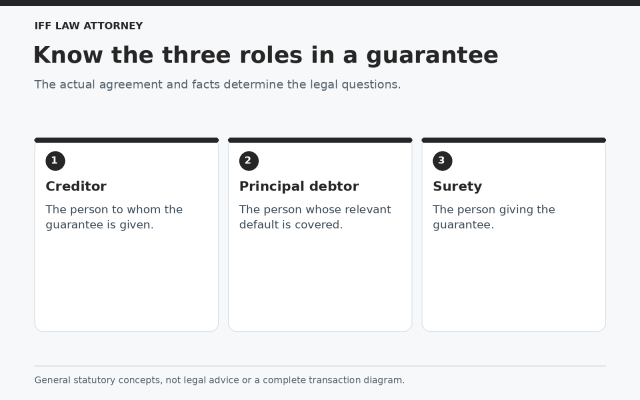
Section 126 of the Indian Contract Act, 1872 describes a contract of guarantee as a promise to perform another person's promise or discharge that person's liability in case of default. The person giving it is the surety, the person whose default is covered is the principal debtor, and the recipient is the creditor.
Section 128 states that the surety's liability is co-extensive with that of the principal debtor unless the contract provides otherwise. The wording of the guarantee therefore matters. Do not assume that a business's separate legal identity answers the question of a personal undertaking.
Sections 129 and 130 address continuing guarantees and revocation as to future transactions. Revocation should not be confused with erasing an obligation already incurred. The complete document and transaction history need review before any conclusion about a person's exposure.
First, identify everyone correctly
Write down the legal names of the creditor, the business receiving the credit and every proposed guarantor. Check that the names in the guarantee match the underlying transaction documents. Trading names and familiar group names can hide important distinctions between entities.
If several related businesses are involved, ask exactly whose obligations are covered. A reader may be thinking about one operating company while the wording refers to a wider set of obligations or facilities. Have that difference explained before signing.
Check each signature block. In which capacity is the person signing? Which signatures concern the company, and which concern the individual? Do not rely on an informal description of the paperwork when the document itself uses a different structure.
Find the obligation behind the guarantee
A guarantee should be read alongside the agreement or facility it supports. Ask for the complete relevant terms, schedules and amendments. A short guarantee can refer to a much longer document that defines the underlying debt, default or payment obligations.
Clarify whether the proposed promise relates to one identified transaction, a series of supplies, an existing balance or future dealings. Ask what happens when an account is settled and used again. Keep the answer connected to the written terms.
If a commercial explanation says the arrangement is limited to one order, check where that boundary appears in the document. A verbal assurance and a broad written clause should be reconciled before the signature is obtained.
Ask what the stated limit includes
A number on the first page may not answer every question about the financial scope. Ask how the document treats principal, interest, charges, costs and other amounts. If a cap is intended, have an advocate explain whether the wording expresses the intended overall boundary.
Distinguish the business's credit limit from the wording of the individual's guarantee. Do not assume they are automatically identical. Ask what happens if the commercial limit is increased, another facility is added or an old balance is carried forward.
Prepare a short written summary of your understanding and compare it with the proposed text. This is a way to expose questions for review, not a substitute for the document. The useful outcome is a clear explanation of the actual terms.
Check how the arrangement continues
Ask when the proposed guarantee begins, what dealings it covers and what event is intended to end it. If there are notice requirements, identify the recipient, address and method described in the document. Keep these details in a place the business and individual can find later.
Discuss what happens if the guarantor leaves the company, sells shares or retires from a business role. A change in the person's relationship with the business should trigger a review of the guarantee records and any required release arrangements.
Do not treat resignation paperwork, a private understanding with another owner or a friendly email as proof of release without legal review. Ask what evidence from the relevant creditor and what further documents are needed for the particular arrangement.
Read changes and notices together
Business relationships evolve. Payment terms change, balances are disputed, facilities are renewed and account responsibilities move between people. Keep any proposed change connected to the guarantee review instead of leaving it solely in the procurement or finance team's correspondence.
Ask how the document deals with amendments and what information the guarantor will receive. Which account statements, default communications or notices should be retained? Who in the organisation will make sure they reach the right person?
These questions are especially useful when the person giving the guarantee is not involved in daily accounting. A promise can be difficult to monitor when the individual has no reliable view of the transactions it is meant to cover.
A hypothetical supplier-credit example
Imagine a Chennai manufacturing company opening a supplier credit account. An owner signs a document believing it relates only to the first order. Later, the business places further orders and agrees revised payment terms. This is an invented example, not an IFF Law Attorney client matter.
When a payment dispute arises, the useful questions concern the actual file: what did the guarantee identify, what transactions followed, what changes were agreed and what notices were exchanged? The owner's original understanding needs to be compared with those records.
The example does not establish whether the owner is liable or discharged. It shows why the review should happen while the terms can still be discussed. A clearly identified transaction boundary and a complete signed copy are more useful than trying to reconstruct a conversation months later.
Keep a personal copy of the complete file
Retain the signed guarantee, the related agreement, schedules, amendments, correspondence and relevant account records. Make sure the copy includes all pages and the final agreed version. A photograph of only the signature page will rarely answer a detailed question about scope.
Record where the original is kept and who holds the current document set. Keep personal records secure and share them through an appropriate channel when obtaining advice. Avoid placing private financial information in a general business chat group merely for convenience.
If there is more than one guarantor, obtain advice on the actual arrangements rather than assuming everyone has the same position. Different documents, limits and transaction histories can create questions that a shared spreadsheet does not resolve.
If a demand arrives, preserve it and obtain advice
Keep the full demand, attachments, envelope or delivery record and the related communications. Note when it was received. Gather the signed documents and account history before making a substantive response or signing any proposed acknowledgement or settlement.
Ask an advocate to assess the terms, facts, forum, applicable law and any time-sensitive steps. A demand should not be ignored because the individual believes the creditor must deal only with the business. Equally, receiving a demand does not, by itself, establish that every amount claimed is payable.
A focused review separates what is admitted, what is disputed, what documents are missing and what action is needed next. Avoid relying on a generic internet notice or a response copied from an unrelated case.
Questions to take into the review meeting
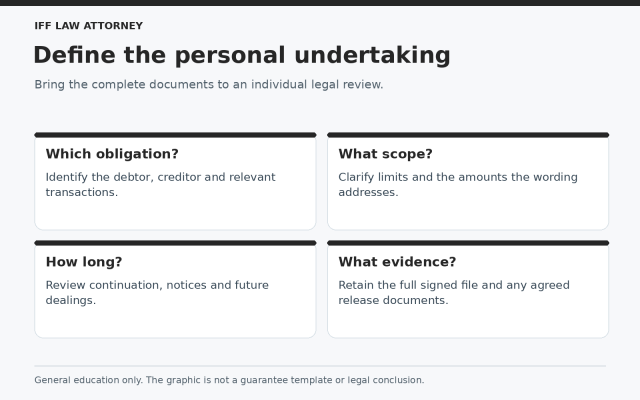
- Which legal entity and underlying obligations are covered?
- In which capacity does each person sign?
- Does the arrangement cover one transaction or a series?
- What amounts fall within the proposed limit?
- How are changes, notices and future dealings addressed?
- What happens when the individual's business role ends?
- What written evidence would establish an agreed release?
- Which complete records should the individual retain?
The point is to understand the promise before accepting it and to keep enough evidence to review it later. A document described as standard can still have significant consequences for the person signing.
IFF Law Attorney shares this article as general legal education for Indian businesses. Obtain advice from an advocate on the complete documents and facts before signing, responding to a demand or taking action.
Disclaimer: This article is for general information and education. It is not legal advice, does not create an advocate-client relationship and does not promise a result. Applicable law, contractual terms, forum and facts require individual review. This content is not a solicitation.
Statutory reference
India Code: Indian Contract Act, 1872, particularly sections 126, 128, 129 and 130