

For years, employers heard that India’s new Labour Codes were “coming soon.” That wait is over. The Government of India made all four Labour Codes effective from 21 November 2025. In May 2026, the Central Government also issued final Central Rules for establishments where the Central Government is the proper authority.
This is not only a payroll update. The new Labour Codes affect wages, overtime, appointment letters, PF, ESI, gratuity, contract labour, safety, complaints, standing orders and retrenchment.
For Tamil Nadu employers, one more point is important. A rule made by the Central Government does not automatically apply to every private company in Tamil Nadu. The first question is whether the Central Government or the Tamil Nadu Government is the “appropriate government” for that establishment. Existing rules, notifications, standards and schemes may also continue during the changeover where applicable.
Start with your own business, employee count and type of work. A checklist made for a bank or mine may not fit a private factory or Chennai IT office.
Here are nine practical checks for new labour codes employer compliance in India, written especially for employers, factories and HR teams in Tamil Nadu.
What are the four new Labour Codes?
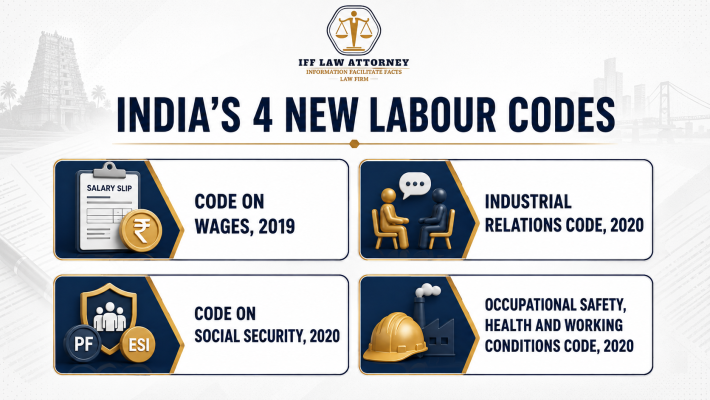
The new system brings 29 Central labour laws under four main Codes:
- The Code on Wages, 2019
- The Industrial Relations Code, 2020
- The Code on Social Security, 2020
- The Occupational Safety, Health and Working Conditions Code, 2020
The purpose is to give one clearer system in place of many old laws. But “simpler law” does not mean “no compliance.” Employers still need correct documents, records, payments and proof.
Check 1: Map every worker and find the correct government
Before changing salary sheets or HR policies, prepare a full worker map. List permanent employees, trainees, fixed-term employees, contract labour, apprentices, part-time staff, supervisors, managers, sales staff, inter-State migrant workers and people working through a platform or agency.
The words “employee,” “worker,” “fixed-term employee” and “contract labour” do not always mean the same thing. A duty may cover all employees, only workers, or only a unit above a set worker count.
Next, identify the appropriate government. The Central Government is the authority for specified sectors and establishments, such as railways, mines, major ports, banking and certain Central Government controlled bodies. The Tamil Nadu Government is generally the authority for many other private establishments in the State.
Create a one-page sheet showing:
- Each unit, business type and worker count
- Contract labour and migrant worker count
- PF, ESI, factory and other registrations
- Whether Central or Tamil Nadu rules apply
This one sheet will guide every other labour law compliance decision.
Check 2: Review the wage structure and the 50% rule correctly
The wage definition is one of the biggest changes under the new Labour Codes. It includes basic pay, dearness allowance and retaining allowance, if any. Items such as house rent allowance, conveyance allowance, overtime allowance, commission and the employer’s PF contribution are generally listed outside wages for this formula.
However, there is a 50% limit. If the listed exclusions cross 50% of total pay, the excess is added back to wages. This wage figure can affect gratuity and other legal calculations.
Here is a simple example. Assume an employee’s pay for the formula is ₹40,000. Basic pay and dearness allowance together are ₹16,000. The listed excluded items total ₹24,000. Since 50% of ₹40,000 is ₹20,000, the extra ₹4,000 is added back. The wage figure becomes ₹20,000 for the relevant Code calculation.
This is why the popular line “basic salary must be exactly 50% of gross salary” is not fully correct. The law applies a wage definition and an add-back formula. Employers should review each pay item, not merely rename allowances in the salary slip.
The revised wage definition has applied from 21 November 2025. The Ministry’s March 2026 FAQ also states that gratuity based on the revised wage definition applies from that date. Payroll software, CTC letters and gratuity provisions should match the legal formula.
Check 3: Test minimum wages, payment dates and deductions
Compare actual pay with the latest minimum wage rate for the work, skill level, zone and industry. A higher CTC does not always prove compliance because reimbursements and yearly benefits may not cure a short monthly wage payment.
The Code on Wages also fixes clear payment timelines. Daily wages must be paid at the end of the shift. Weekly wages must be paid on the last working day of the week. Fortnightly wages must be paid within two days after the fortnight ends. Monthly wages must be paid before the end of the seventh day of the next month.
When an employee resigns, is dismissed or is terminated, due wages must generally be paid within two working days. HR teams should update their full and final settlement process so that internal approvals do not delay wage payment.
Deductions also need proof. Only authorised deductions can be made, and total deductions in a wage period should not cross 50% of wages. Before deducting money for damage or loss, give the employee a fair chance to explain. Keep the notice, reply, finding and calculation in the employee file.
Check 4: Recheck working hours, overtime, rest days and leave
The 2026 Central wage rules use an eight-hour normal working day and a maximum of 48 hours in a week for covered employees. The Ministry’s March 2026 FAQ also says that a worker who works for more than eight hours in a day or more than 48 hours in a week is entitled to overtime at twice the normal wage rate under the relevant provision.
Tamil Nadu employers must still check the exact rule that applies to their establishment. A factory, shop, office, motor transport unit and construction site may not follow the same shift system. If a Tamil Nadu rule gives a better benefit to the employee, that benefit may need to be protected.
Match biometric data with shift rosters, gate records and overtime sheets. Different working-hour records can weaken the employer’s case.
Review weekly rest, spread-over time, night shifts and leave records as well. Under the Ministry’s 2026 guidance, eligible workers can normally carry forward up to 30 days of leave. Leave applied for but refused may be carried forward without that normal limit. The exact coverage depends on whether the person falls within the legal meaning of “worker” and on the applicable rules.
Check 5: Issue proper appointment letters and maintain proof
An appointment letter is no longer a document to give only to office staff. The employer compliance handbook says appointment letters should be issued to all employees. This includes eligible shop-floor and fixed-term staff.
Each letter should clearly state the job, wage, pay period, work location, hours, leave, probation or fixed term, notice rule, benefits and key service conditions. It should not contain a clause that removes a right given by law.
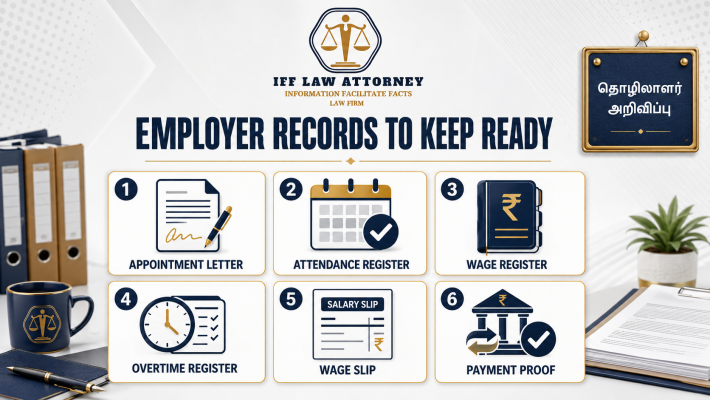
Employers should also maintain employee, attendance, wage, overtime, advance, fine and deduction records in the prescribed form. Wage slips must be issued on or before wage payment. Under the Central wage rules, covered records must be kept for five years after the last entry. Tamil Nadu establishments should confirm the State form and period applicable to them.
Check the workplace notice board too. Required details may include minimum wages, normal working hours, wage period, payment date and inspector details. Use Tamil as the local language where required, along with the other prescribed languages.
HR should be able to produce the appointment letter, wage slip, attendance record and payment proof together.
Check 6: Review PF, ESI, gratuity and maternity benefits
Social security mistakes can grow into large claims because they continue every month. Prepare an employee-wise review of PF, ESI, gratuity and maternity benefit coverage.
The employer handbook states that PF provisions apply to establishments with 20 or more employees. It states that ESI provisions apply to establishments with 10 or more persons, and may apply to hazardous or life-threatening work even with one employee. The Ministry’s March 2026 FAQ says the present ESI wage limit of ₹21,000 per month continues until it is changed by notification.
Do not change PF or ESI rates based on a social media post. Check the current scheme, notification and applicable rule.
For gratuity, the usual five-year continuous service rule continues for regular employees, subject to legal exceptions such as death or disablement. A directly hired fixed-term employee can become eligible after completing one year under the contract. The Ministry has clarified that fixed-term employment does not include contract labour hired through a contractor. Gratuity should be paid within 30 days after it becomes due.
Maternity records also need review. An eligible woman employee who worked for at least 80 days in the prior 12 months may receive up to 26 weeks of maternity benefit, subject to the law. Establishments with 50 or more employees should check crèche duties and the option of using a permitted common crèche.
Check 7: Audit contractors and inter-State migrant workers
“The contractor handles it” is not a safe answer. Under the employer handbook, the contract labour provisions apply when 50 or more contract workers were employed on any day during the previous 12 months. A contractor employing 50 or more contract workers must obtain the required licence.
The principal employer is responsible for prescribed welfare facilities. If the contractor fails to pay wages on time or pays less, the principal employer can become liable to pay the contract labour and recover the amount from the contractor.
Every month, collect and check the contractor’s attendance, wage sheet, bank payment proof, wage slips, PF and ESI payment details, employee list and licence status. Match them against gate-entry records. A PDF sent by the contractor is not enough if the names or days do not match the people who worked at the site.
Special duties can apply where 10 or more inter-State migrant workers were employed in the prior 12 months. These may include a yearly journey allowance for travel between the work location and the worker’s native place.
Update vendor contracts with compliance duties, document deadlines, audit rights and recovery terms.
Check 8: Inspect workplace safety, welfare and night-shift systems
Safety compliance is not limited to large factories. The OSH Code covers many establishments with 10 or more workers, while special rules apply to factories, construction, mines, transport and other work.
Check machine guards, electrical safety, fire exits, water, toilets, light, air flow, first aid and protective equipment. Record safety training and provide free annual health checks where required.
Women may work in all types of work, but consent and prescribed safety steps are required for work before 6:00 a.m. or after 7:00 p.m. Transport, security, lighting, supervision, rest and complaint support should exist in practice, not only in a policy file.
Create a written accident plan. Serious accidents, dangerous events and listed work-related diseases must be reported in the correct form and within the time set by the applicable government. Train more than one person to handle the report so compliance does not stop when the safety officer is absent.
Check 9: Build a system for complaints, standing orders and job cuts
Many labour disputes begin with a small complaint that was ignored. An industrial establishment with 20 or more workers must have one or more Grievance Redressal Committees under the Industrial Relations Code. The committee must have equal employer and worker representation, proper representation of women, and no more than ten members. It should normally finish a matter within 30 days.
Industrial establishments with 300 or more workers must review the standing order requirements. If an employer wants to change a listed service condition, a 21-day notice may be required before the change takes effect.
Lay-off, retrenchment and closure are high-risk events. For specified factories, mines and plantations with 300 or more workers, prior government permission may be needed. Retrenchment can also involve notice, compensation and a contribution equal to 15 days’ wages to the worker re-skilling fund.
Before termination, check the person’s legal status, contract, enquiry process, notice, compensation, government filing and pending dispute. One missed step can lead to long litigation.
A simple 30-day action plan for Tamil Nadu employers
Week 1: Map establishments, employee groups, worker counts, contractors and the appropriate government.
Week 2: Audit salary structure, minimum wages, overtime, deductions, wage slips, appointment letters and final settlement timelines.
Week 3: Review PF, ESI, gratuity, maternity benefit, contractor records, licences, migrant worker duties and workplace safety.
Week 4: Form or update required committees, train HR and managers, fix standing orders and prepare one digital compliance folder for each unit.
Do not wait for an inspection notice. A calm review today costs less than correcting twelve months of payroll, contractor and record mistakes later.
Frequently asked questions
Are the new Labour Codes active in India in 2026?
Yes. The Central Government made all four Labour Codes effective from 21 November 2025. Final Central Rules were notified on 8 May 2026 for establishments where the Central Government is the appropriate government.
Does the 50% wage rule mean basic pay must always be 50%?
No. The law defines wages and lists certain exclusions. If the listed exclusions cross 50% of total pay for the formula, the excess is added back to wages. Each salary component must be checked.
Do the Central Rules apply to every Tamil Nadu company?
No. Employers must first identify the appropriate government. Many private establishments come under the Tamil Nadu Government, while specified sectors and establishments come under the Central Government.
Can a company give compensatory leave instead of overtime pay?
Do not assume compensatory leave removes the duty to pay overtime. Where the Code requires overtime, the applicable rate is generally twice the normal rate. Check the law and rules that cover the establishment and employee.
Final word
New labour codes employer compliance in India is not a one-time form-filling job. It connects payroll, HR, finance, factory operations, safety, contractors and management decisions. The strongest system is one where all these teams use the same worker data and keep matching proof.
IFF Law Attorney shares this article to help employers, factories and HR teams in Tamil Nadu understand the new Labour Codes in simple language. Businesses may use a regular legal compliance review or retainership system to check documents, prevent disputes and respond to notices in an organised way. The exact legal step will depend on the establishment, industry, employee count, government authority and latest notification.
General legal awareness only. Not legal advice or solicitation.
#labourcodes #employercompliance #tamilnadu #hrcompliance #labourlaw
Official sources used
- Government makes the four Labour Codes effective from 21 November 2025
- Ministry of Labour and Employment: Compliance Handbook for Employers Under the Four Labour Codes
- Ministry of Labour and Employment: Additional FAQs on Labour Codes, 16 March 2026
- Code on Wages (Central) Rules, 2026
- Industrial Relations (Central) Rules, 2026
- Social Security (Central) Rules, 2026
- Occupational Safety, Health and Working Conditions (Central) Rules, 2026