
Living in a flat is peaceful until the end of the month when the maintenance bill arrives. You open it and see an unexpected "extra charge." Maybe it is a "festival fund," a "painting fee," or a "transfer fee" because you are planning to sell the flat. Naturally, you wonder, "Is this even legal? Do I really have to pay this?"
IFF Law Attorney may consider enquiries relating to this topic. The available steps and scope of any engagement depend on the facts, records, applicable law and acceptance of the matter.
In this blog, we will answer all your questions about apartment maintenance rules in Tamil Nadu in simple, plain English. We will look at what the law says, what your association can actually collect, and what you can do if they ask for extra money illegally.
What Exactly Are Maintenance Charges?
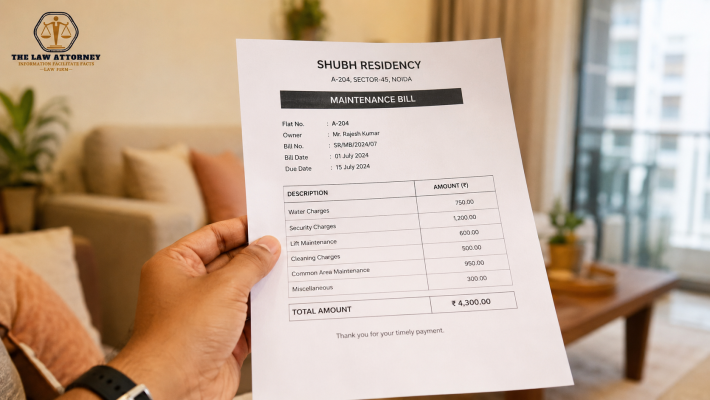
Before we talk about the extra amounts, let us quickly look at what normal maintenance charges are. When you buy a flat, you only own the inside of your house. But you share the outside areas with everyone else. These shared areas are called "Common Areas."
Common areas include:
- Staircases and lifts
- Corridors and lobbies
- The land the building stands on
- Parks, play areas, and gyms
- Security guards and cleaning staff
- Water tanks and common electricity
To keep these areas clean and working, every flat owner has a legal duty to pay a monthly or yearly fee. Under the Tamil Nadu Apartment Ownership Act, 2022, paying this maintenance fee is mandatory. It is not an option.
How is the Bill Calculated?
Associations usually calculate this bill in two ways:
- Per Square Foot Method: If you have a larger flat (say, a 3BHK), you pay more than someone who owns a smaller flat (like a 1BHK). This is the most common method in Tamil Nadu.
- Equal Fee Method: Every flat pays the exact same amount, no matter how big or small the house is. This is usually seen in smaller apartment buildings.
The Big Question: Can Associations Ask for Extra Money?
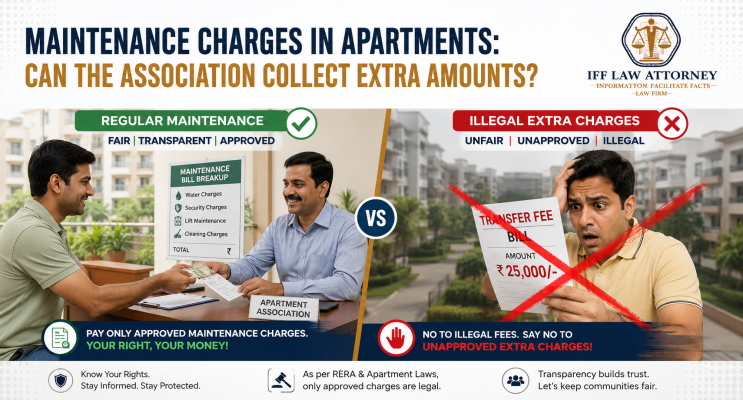
The short answer is No. The association cannot wake up one morning and decide to charge you an extra penalty, a random fee, or a high "corpus fund" without following strict legal rules.
Let us break down the exact laws that protect you.
1. The Real Estate (Regulation and Development) Act (RERA)
RERA rules say that nobody can make a profit out of maintenance charges. The association is like a manager, not a business. The money collected must be used only to manage the building. If they collect extra money, they must keep it in a separate bank account, audit it every year, and show the accounts to all the flat owners. They cannot add "hidden costs" just to build a huge bank balance.
2. The Famous "Transfer Fee" Issue (Madras High Court Ruling)
This is where most fights happen. Let us say you bought a flat in Chennai five years ago. Now, you want to sell it and move to a new city. When you tell your association, they say, "To give you a No Objection Certificate (NOC), you must pay us 1% of your sale amount or Rs. 50 per square foot as a Transfer Fee."
This can run into lakhs of rupees! Is this legal?
Absolutely not. The Madras High Court gave a very clear ruling on this exact issue. In a famous case from Kilpauk, Chennai, the court said that an apartment association cannot demand a "transfer fee" every time a flat is sold.
The court made three things very clear:
- The job of the association is to maintain the building, not to make money from property sales.
- Collecting huge extra amounts to keep in a "corpus fund" is illegal and causes problems.
- You have a constitutional right to your property. The association cannot stop you from selling it by demanding a ransom.
If your association asks for this, they are breaking the law.
3. Festival Funds and Donations
During Diwali, Pongal, or New Year, the association might want to decorate the building and host a party. Can they force you to pay Rs. 2,000 for the celebration?
Again, no. Donations for festivals or cultural events must be 100% voluntary. They cannot add this to your official maintenance bill and threaten you if you do not pay. If you do not want to participate, you have the right to politely say no.
What is Allowed vs. What is Not Allowed
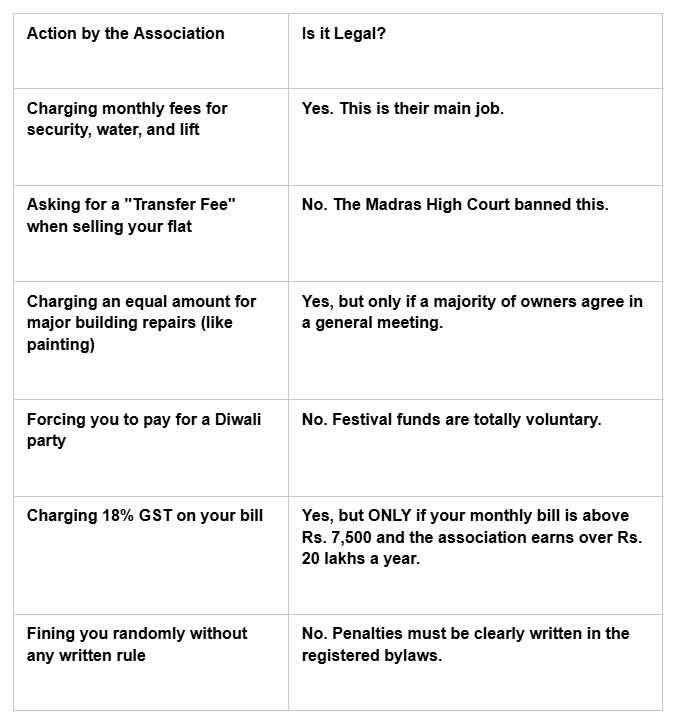
To make it super easy, here is a simple table showing what your association can and cannot do under Tamil Nadu laws:
What Happens If You Do Not Pay the Actual Maintenance?
While the association cannot charge illegal fees, you also have a duty to pay your regular, legal maintenance charges on time. The Tamil Nadu Apartment Ownership Act, 2022, is very strict about this.
If you stop paying your monthly dues, the association has the power to act. But there are rules for them, too.
What the association CANNOT do:
- They cannot stop you from entering your own house.
- They cannot cut off your drinking water supply or electricity, as these are basic human rights.
- They cannot use violence, abuse, or forceful action against you. The court has said that such actions are criminal offences.
What the association CAN do:
- They can charge a late fee or interest, as long as it is mentioned in the registered rules (bylaws).
- They can stop you from using non-essential services. For example, they might block your access to the swimming pool or the clubhouse.
- They can take legal action against you in a civil court to recover the money.
IFF Law Attorney may consider enquiries relating to this topic. The available steps and scope of any engagement depend on the facts, records, applicable law and acceptance of the matter.
The Power of the Bylaws (Rulebook)
Everything your association does must be written in their "Bylaws." The bylaws are like the constitution for your apartment building.
Under the new 2022 Act in Tamil Nadu, forming an association and registering it is mandatory for any building with four or more flats. Unregistered associations have no legal power to collect money or enforce rules.
When the association is formed, they have to draft these bylaws and register them with the government. If the association wants to change a rule (for example, they want to start charging for second car parking), they cannot just announce it on a WhatsApp group. They have to call for a proper meeting, get the majority of owners to vote yes, and then get the new rule approved by the Registrar of Societies. If they do not follow this process, the new rule is useless.
How to Handle Illegal Demands
If your association drops a massive "extra charge" on your desk, do not panic. Here is a step-by-step guide on what you should do:
Step 1: Ask for a Written Explanation
Never argue verbally. Send an email or a formal letter to the association president or secretary. Ask them to give you the exact breakdown of the extra charge. Ask them to show you which specific rule in the registered bylaws allows them to ask for this money.
Step 2: Demand Transparency
As a flat owner, you have the right to check the account books. Ask to see the bank statements and the audit reports. Many times, just asking for the accounts makes associations back down from illegal demands, because they know they have no proof.
Step 3: Gather Other Owners
If the association is charging you an extra fee, they are probably charging others, too. Talk to your neighbours. If a single flat owner complains to the Registrar of Societies, the government can take action. But if ten owners complain together, the impact is much stronger.
Step 4: Send a Legal Notice
If the association starts harassing you, sending angry messages, or trying to block your car from entering the gate, it is time to take legal action. This is where you need a professional lawyer. A legal notice may be considered after review, but it does not guarantee that the matter will be resolved without court proceedings.
Legal assistance in this area
Property laws can be confusing. The rules keep changing, and associations sometimes act like bullies because they think individual owners will not fight back. But you do not have to fight alone.
IFF Law Attorney may consider enquiries relating to this topic. The available steps and scope of any engagement depend on the facts, records, applicable law and acceptance of the matter.
Here is how we can help:
- For Flat Owners: If your association is demanding illegal transfer fees, cutting off your water, or harassing you with high penalties, we can step in. We will review your association's bylaws, send a powerful legal notice, and file complaints with the Registrar of Societies or the RERA court if needed.
- For Apartment Associations: Running a building is hard work. If you are an honest association trying to collect unpaid dues from a difficult resident, or if you need to register your association properly under the new Tamil Nadu Apartment Ownership Act, 2022, we offer retainership services. We will draft clean, legal bylaws so you never face trouble from the law.

Summary for Apartment Owners
Living in a community means cooperating with each other, but it does not mean blindly paying whatever is asked. Let us quickly recap the most important points:
- Maintenance charges are only for managing common areas.
- The association cannot make a profit from you.
- Extra "transfer fees" during resale are strictly illegal in Tamil Nadu.
- Festival funds are voluntary, not mandatory.
- Any new rule or charge must be voted on and added to the registered bylaws.
- The association cannot stop you from entering your house or cut off your basic water and electricity.
Your home is your biggest investment. Protecting your peace of mind is just as important as protecting the walls and the roof. If you are facing unfair extra charges, do not pay blindly. Ask questions, read the rules, and know your rights.
IFF Law Attorney may consider enquiries relating to this topic. The available steps and scope of any engagement depend on the facts, records, applicable law and acceptance of the matter.