
Introduction: Business Problems Do Not Always Come With Warning
Running a business is not only about sales, customers, staff, profit, and growth. Behind every business, there are many legal areas that need care. A rental agreement, employee issue, vendor payment, partnership dispute, customer complaint, government notice, contract draft, cheque issue, GST-related communication, property document, or legal notice can come at any time.
Many company owners wait until a legal problem becomes serious. Only after receiving a notice, court summons, police complaint, or payment dispute, they start searching for a lawyer. By that time, the issue may already be bigger, costlier, and more stressful.
This is where a legal retainer for business becomes useful.
A legal retainer means a business keeps a lawyer or law firm available for regular legal support. It is like having a legal partner who understands your business and helps you handle legal matters from time to time.
For business owners in Tamil Nadu, especially small companies, startups, traders, manufacturers, service providers, agencies, real estate businesses, and family-run businesses, legal retainership can bring order, safety, and confidence in daily business decisions.
Important legal publishing note: In India, advocates are restricted from advertising or soliciting work. Rule 36 of the Bar Council of India Rules prohibits direct or indirect advertising and solicitation by advocates, and the Government has also referred to this rule in relation to online legal services. This blog is written only for general legal awareness and education. It is not an advertisement or legal advice.

What Is a Legal Retainer for Business?
A legal retainer is an arrangement where a business gets regular legal support from a lawyer or law firm for a fixed period, usually monthly, quarterly, or yearly.
Instead of calling a lawyer only when there is a problem, the business gets legal guidance in a planned way. The lawyer becomes familiar with the company’s work, documents, risks, and common legal needs.
In simple words, a legal retainer is like this:
You do not wait for a fire to call for safety. You keep a safety system ready.
In the same way, a legal retainer helps a business keep legal support ready before problems become serious.
For example, a business owner may need help with:
- Reviewing rental agreements
- Drafting vendor contracts
- Sending legal notices
- Replying to legal notices
- Checking partnership terms
- Handling payment recovery matters
- Managing employee-related legal issues
- Reviewing business documents
- Guiding on civil or criminal complaints linked to business
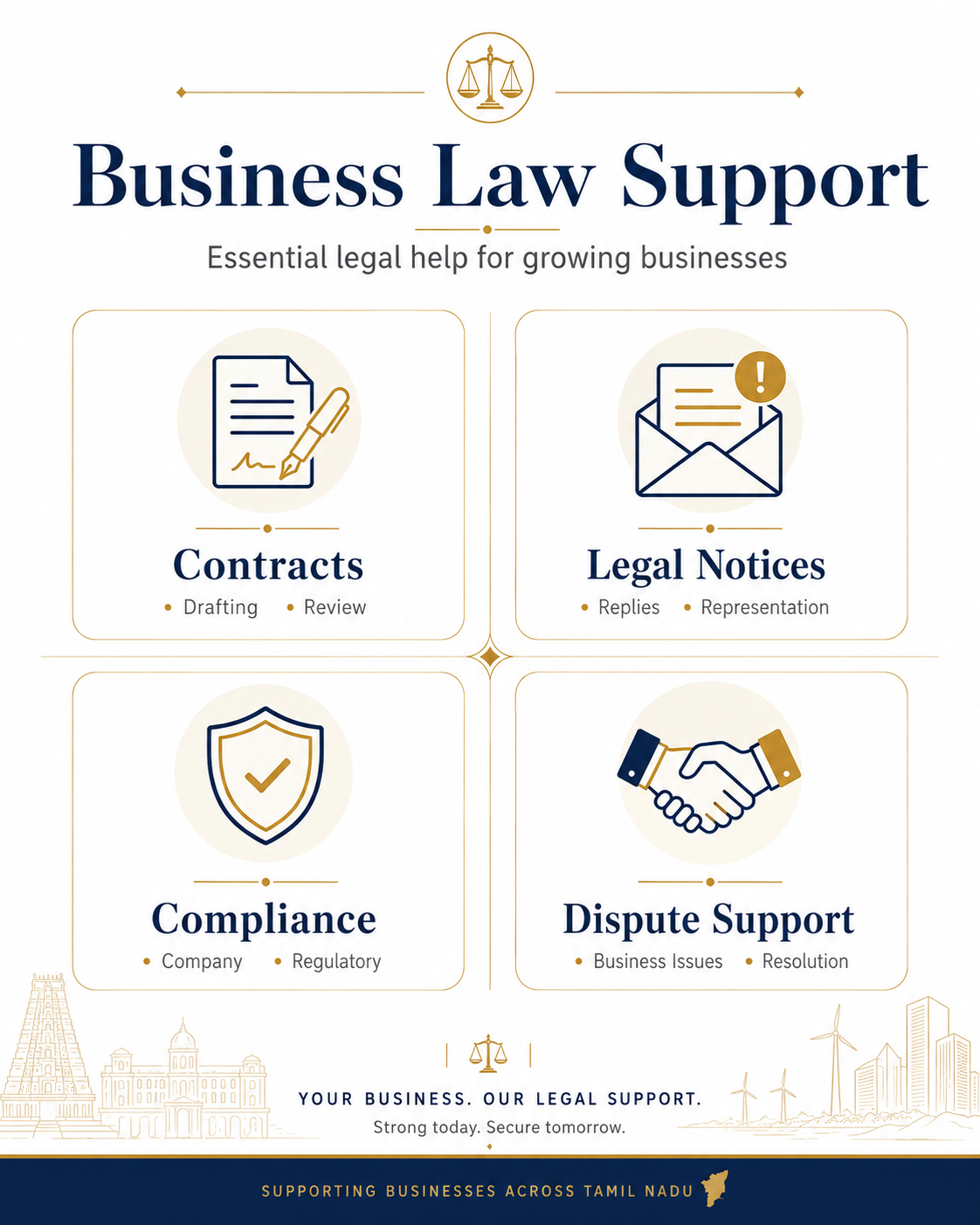
- Supporting non-litigation work
- Preparing business agreements before signing
A legal retainer does not mean that all court cases are automatically covered. The exact scope depends on the agreement between the business and the law firm. Some retainers cover only advisory and document review. Some include drafting. Some include legal notices. Some may include separate litigation support with separate fees.
That is why the retainer terms must be clear from the beginning.
Why Business Owners Need Regular Legal Support
Many business owners are strong in their field. A factory owner knows production. A trader knows buying and selling. A builder knows construction. A digital agency owner knows marketing. A restaurant owner knows food and service.
But legal matters are different.
A small wording mistake in an agreement can create a big loss. A casual WhatsApp promise can become evidence. A poorly drafted invoice term can affect payment recovery. A rental agreement without proper exit terms can create business pressure. A partnership without clear roles can become a dispute.
Legal problems often start small.
A vendor delays payment. A landlord changes terms. A customer refuses to clear dues. An employee leaves with company data. A partner starts taking decisions alone. A supplier fails to deliver goods. A client asks for refund without reading the agreement.
At first, these issues may look like normal business tension. But if they are not handled properly, they can become legal disputes.
A legal retainer helps business owners take the right step at the right time.
Legal Retainer Means Prevention, Not Only Problem Solving
Many people think lawyers are needed only for court cases. That is not correct.
A major part of business law is preventive work. Preventive legal support means taking care of documents, communication, contracts, notices, and decisions before a dispute becomes serious.
For example, before signing a commercial lease, a lawyer can review:
- Rent amount
- Lock-in period
- Security deposit
- Maintenance charges
- Termination clause
- Notice period
- Business use clause
- Subletting restriction
- Renewal terms
- Dispute clause
If the business owner signs without reading these points, problems may come later. If the document is reviewed before signing, the owner can avoid many risks.
This is the main value of a legal retainer. It helps a company avoid common legal mistakes.
How a Legal Retainer Helps in Contracts
Contracts are the backbone of business.
Every business deals with some type of agreement. It can be a vendor agreement, service agreement, employment agreement, partnership deed, franchise agreement, lease deed, purchase order, quotation, invoice terms, non-disclosure agreement, or payment terms document.
Many business owners use sample agreements from the internet. This may look easy, but it can be risky. A general format may not suit your business, your state, your transaction, or your risk.
A proper business contract should clearly say:
- Who are the parties?
- What work will be done?
- What is the payment?
- When should payment be made?
- What happens if payment is delayed?
- Who is responsible for loss or damage?
- How can the agreement end?
- What happens if there is a dispute?
- Which court or place will handle disputes?
- What records should be kept?
A legal retainer helps business owners review these points regularly. Before signing a document, the business can get legal clarity. This avoids confusion and protects the company.
How Retainership Helps in Payment Recovery
Payment delay is one of the most common problems faced by business owners.
A client may say, “We will pay next week.” A vendor may say, “Please adjust this month.” A customer may stop replying. A company may delay the invoice for months.
In many cases, business owners keep waiting because they do not want to spoil the relationship. But at some point, waiting without proper legal action may weaken the recovery process.
With legal retainership, the lawyer can guide the business on:
- Proper invoice wording
- Written follow-up communication
- Payment reminder format
- Legal notice timing
- Evidence collection
- Cheque bounce steps, if applicable
- Civil recovery options
- Negotiation approach
This does not mean every payment issue must go to court. Many matters can be handled through proper legal communication. A well-drafted notice or reply can bring seriousness to the issue.
How a Legal Retainer Helps With Legal Notices
Legal notices are common in business.
A business may receive a notice from a customer, supplier, landlord, employee, partner, bank, government department, or another company. Many owners panic when they receive a legal notice.
Some ignore it. Some reply emotionally. Some call the other party and make statements without understanding the legal effect. Some forward it to random people and get confused.
A legal retainer helps because the business already has legal support available. The notice can be reviewed calmly. The facts can be checked. Documents can be arranged. A proper reply can be prepared.
This is important because a legal notice reply may later become part of the dispute record. A wrong reply can harm the business. A careful reply can protect the business position.

How Legal Retainership Supports Startups
Startups move fast. Founders often focus on product, funding, clients, hiring, marketing, and growth. In that speed, legal documents are often ignored.
But startups need legal clarity from the early stage.
A startup may need help with:
- Founder agreement
- Equity and ownership understanding
- Investor communication
- Vendor contracts
- Employment terms
- Consultant agreements
- Non-disclosure agreements
- Website terms and privacy policy
- Brand protection
- Service terms
- Exit terms between founders
A legal retainer can help a startup build a clean legal base. This is useful when the startup grows, takes investment, hires employees, or enters into large contracts.
A small legal mistake in the beginning can become a large founder dispute later. That is why regular legal support can help startups stay stable.
How Legal Retainership Helps Family Businesses
Tamil Nadu has many family-run businesses. These businesses may be in trading, textiles, construction, transport, food, manufacturing, finance, retail, or service fields.
Family businesses often run on trust. But even in family businesses, written clarity is important.
Common issues include:
- Who owns the business?
- Who handles money?
- Who takes decisions?
- What happens if one person exits?
- How will profit be shared?
- What happens after the next generation joins?
- Who signs documents?
- Which property belongs to business and which belongs to family?
A legal retainer can help family businesses organise documents, draft agreements, and avoid future misunderstandings.
This is not about creating fear. It is about creating clarity.
How Retainership Helps With Employment Issues
Employees are important for every business. But employee-related legal issues can arise in many ways.
For example:
- Appointment letters are not clear
- Salary terms are not written properly
- Non-compete or confidentiality terms are missing
- Employee leaves suddenly
- Company data is taken away
- Workplace complaint is raised
- Termination is not handled properly
- Full and final settlement becomes a dispute
A legal retainer helps the business draft proper employment documents and handle employee issues in a careful manner.
This is especially useful for growing businesses that are hiring more people. When the team grows, written rules become important.
How Retainership Helps in Compliance and Documentation
A business may have to maintain different types of records depending on its nature. A private limited company, partnership firm, LLP, MSME, shop, factory, agency, or service business may have different legal and document needs.
India has a large MSME base, and official MSME dashboard data shows that MSME registrations under Udyam and Udyam Assist continue to be tracked in crores. This shows how many small and medium businesses are becoming more formal and document-based.
For a business owner, this means one thing: documents matter.
A legal retainer can help in checking whether important legal papers are in order, such as:
- Partnership deed
- Company documents
- Vendor contracts
- Lease documents
- Employee agreements
- Board or partner decisions
- Authorisation letters
- Legal notices
- Replies
- Business terms and conditions
- Customer agreements
Retainership helps a business build a habit of legal order.
Legal Retainer for Litigation and Non-Litigation
IFF Law Attorney works in both litigation and non-litigation legal areas. For business owners, both areas are important.
Litigation means court-related or dispute-related work. This may include civil cases, criminal complaints connected to business, cheque bounce matters, recovery cases, injunction matters, property disputes, contract disputes, and other legal proceedings.
Non-litigation means legal work outside court. This may include drafting, review, notices, agreements, registration support, legal opinions, document checking, compliance-related support, and advisory work.
A legal retainer can be structured to support both areas depending on the business need.
For example, a business may need monthly support for contracts and notices, and separate support if a court case arises. Another business may need more focus on recovery notices and dispute prevention. A startup may need more help with founder terms and vendor agreements.
There is no one-size plan. A proper retainer should match the business.
What Can Be Included in a Business Legal Retainer?
A legal retainer may include different services based on the agreement. Common areas may include:
1. Regular Legal Consultation
Business owners can discuss legal doubts before taking decisions. This helps avoid wrong steps.
2. Contract Review
The law firm can review agreements before signing and point out risk areas.
3. Drafting of Documents
This may include notices, replies, letters, agreements, terms, declarations, and other business documents.
4. Legal Notice Support
The lawyer can draft, send, or reply to legal notices based on facts and documents.
5. Business Dispute Guidance
If a dispute starts, the business can get early guidance on how to respond.
6. Litigation Guidance
If the matter needs court action, the lawyer can guide the next steps.
7. Compliance Document Review
The lawyer can review basic business legal records and suggest corrections.
8. Risk Review
The law firm can identify areas where the business is legally weak and needs better documents.
What May Not Be Included in a Retainer?
This is also important.
A legal retainer does not automatically mean every legal work is included. Some services may need separate professional fees, court fees, filing expenses, stamp paper cost, registration cost, travel cost, or special drafting charges.
For example, a major court case, complex property dispute, arbitration, company restructuring, large transaction, or urgent litigation may be treated separately.
So, before starting a legal retainer, the business owner should ask:
- What services are included?
- How many consultations are included?
- How many drafts are included?
- Are legal notices included?
- Are court cases included or separate?
- What is the response time?
- What documents should be shared?
- What is the monthly or yearly fee?
- How can the retainer be renewed or ended?
Clear terms help both the business and the law firm.
Real-Life Example: Why a Retainer Can Save Time
Let us imagine a small manufacturing company in Tamil Nadu.
The company supplies machine parts to different buyers. One buyer delays payment for four months. The company owner keeps calling. The buyer keeps saying “next week.” Finally, the owner gets angry and sends a harsh message on WhatsApp.
After that, the buyer replies saying the goods were defective and refuses to pay.
Now the issue has become a dispute.
If the company had legal retainer support, the steps could have been cleaner:
First, the invoices and delivery records could be checked. Second, payment reminder emails could be sent in proper wording. Third, the delay could be recorded. Fourth, a legal notice could be sent at the right time. Fifth, the business owner could avoid emotional messages that may weaken the case.
This is how regular legal guidance helps in practical business life.
Legal Retainer Is Useful for Small Businesses Too
Some business owners think legal retainership is only for big companies. That is not true.
Small businesses may need it even more because they usually do not have an internal legal team.
A small business owner handles sales, staff, accounts, clients, operations, and money pressure. When legal issues come, there may be no time to search for help. A retainer gives quick access to legal understanding.
Businesses that may benefit from legal retainership include:
- Startups
- Agencies
- Shops and traders
- Manufacturers
- Builders and contractors
- Real estate businesses
- Service providers
- IT and digital businesses
- Restaurants and food brands
- Logistics companies
- Export and import businesses
- Family businesses
- Educational institutions
- Healthcare-related businesses
- Partnership firms
- Private limited companies
- LLPs
Every business may not need the same type of retainer. But every serious business needs some level of legal planning.
How to Choose the Right Legal Retainer
Before choosing a retainer, a business owner should understand the business need.
Ask yourself:
- Do I sign many contracts?
- Do I face payment delays often?
- Do I receive legal notices?
- Do I have staff-related legal issues?
- Do I work with many vendors?
- Do I have a rented office, shop, factory, or warehouse?
- Do I want to avoid future disputes?
- Do I need legal help every month?
- Do I want one legal team to understand my business?
If the answer is yes to many of these questions, a legal retainer may be useful.
The best retainer is not the cheapest one. The best retainer is the one that fits your business risk and gives clear support.
Legal assistance in this area
IFF Law Attorney focuses on legal awareness, litigation support, non-litigation work, and business legal retainership. For business owners, the aim of a legal retainer is not to create fear. The aim is to create legal clarity.
A business should know what it is signing. A business should know how to reply to notices. A business should keep its documents in order. A business should avoid careless legal steps. A business should take disputes seriously before they grow.
For Tamil Nadu business owners, legal support is not only needed after a case is filed. It is also needed before signing, before replying, before sending a notice, before entering a partnership, before taking a property on rent, and before making major business decisions.
Common Mistakes Business Owners Make Without Legal Support
Many business disputes happen because of simple mistakes. Some common mistakes are:
- Signing agreements without reading fully
- Using online contract formats without changes
- Not keeping written proof of payment terms
- Giving verbal promises
- Not sending proper reminders for dues
- Ignoring legal notices
- Replying emotionally to disputes
- Mixing personal and business money
- Running partnership business without clear terms
- Not updating old agreements
- Not keeping staff documents properly
- Not checking lease clauses before taking a property
These mistakes can be avoided with timely legal guidance.
Conclusion: A Legal Retainer Gives Business Owners Peace of Mind
A legal retainer is not only a monthly legal service. It is a business safety habit.
It helps company owners make better decisions, manage contracts, handle notices, reduce disputes, protect documents, and take timely legal steps. For business owners in Tamil Nadu, this can be very useful because many businesses are growing fast, working with more clients, hiring more staff, signing more contracts, and facing more legal responsibilities.
Good business is not only about profit. It is also about protection.
When your documents are clear, your contracts are strong, your notices are handled properly, and your legal risks are checked early, your business becomes more stable.
Legal retainership helps business owners move from confusion to clarity.
Disclaimer
This blog is shared by IFF Law Attorney only for general legal awareness and educational purposes. It should not be treated as legal advice, legal opinion, advertisement, solicitation, or invitation for legal work. Legal outcomes depend on facts, documents, applicable law, and case-specific circumstances. Business owners should consult a qualified legal professional for advice based on their specific situation.