
You completed the order. The buyer accepted the goods or used your service. You raised the invoice and paid your own workers, suppliers, rent and tax. Yet the buyer keeps saying, “We will clear it next week.” One week becomes one month. Then 45 days pass.
If this sounds familiar, do not treat the unpaid invoice as a normal delay. For a small business, delayed payment can stop the whole cash cycle. It may affect salaries, fresh orders, stock purchases and loan payments. The good news is that Indian law gives certain micro and small enterprises a special recovery route.
This guide explains MSME payment recovery after 45 days in simple words. It covers the payment rule, interest, documents, demand notice, the MSME ODR Portal and the Micro and Small Enterprises Facilitation Council, commonly called the MSEFC. It also explains what a Tamil Nadu business should check before filing a claim.

First, understand what the 45-day rule really means
Many owners believe that every buyer automatically gets 45 days to pay. That is not correct.
Section 15 of the Micro, Small and Medium Enterprises Development Act, 2006, says that the buyer must pay on or before the date agreed in writing. The written credit period cannot be more than 45 days from acceptance or deemed acceptance of the goods or services.
If there is no written payment term, payment must be made before the “appointed day,” which is linked to a 15-day period from acceptance. You can read the exact rule in the official MSMED Act on India Code.
Here is a simple way to read the rule:
- If the contract says payment in 15 days, payment is due in 15 days.
- If the purchase order says payment in 30 days, payment is due in 30 days.
- If the written term says payment in 60 or 90 days, the MSMED Act still limits the period to 45 days for an eligible micro or small supplier.
- If there is no written payment term, the shorter rule linked to the appointed day may apply.
So, you do not always have to wait for day 45. Once the valid due date has passed, the payment is delayed.
What do “acceptance” and “deemed acceptance” mean?
The date of acceptance matters because it helps decide when the payment clock starts.
In simple terms, the day of actual delivery or the day the service is completed can become the day of acceptance.
If the buyer raises a written objection within 15 days, the acceptance date may move to the date on which the supplier fixes that objection. If the buyer does not raise a written objection within 15 days, the goods or services may be treated as accepted from the actual delivery or service date. This is called deemed acceptance under Section 2(b) of the Act.
That is why proof of delivery is so important. An invoice alone shows that money was claimed. A signed delivery challan, email approval, service completion report, installation record, e-way bill, goods receipt note or buyer message can help show that the work was supplied and accepted.
Does every MSME get this special recovery right?
No. This is one of the most important checks.
Although people commonly search for “MSME payment recovery,” Chapter V of the MSMED Act gives the delayed payment protection to micro and small enterprises that meet the legal meaning of a supplier.
A medium enterprise does not get the same MSEFC benefit under Sections 15 to 19.
The enterprise should also have a valid registration for the relevant period. From 1 April 2025, the revised limits use both investment and annual turnover. The current figures are shown on the Ministry of MSME classification page.
Registration timing also matters. In Silpi Industries v. Kerala State Road Transport Corporation, the Supreme Court held, on the facts before it, that a seller could not use later registration to claim MSMED Act benefits for supplies completed before registration.
The Court also confirmed that limitation law applies to arbitration under Section 18. The practical lesson is simple: check the Udyam registration date, contract date, supply dates and invoice dates before filing. The Supreme Court judgment is available here.
An Udyam certificate alone may not settle every issue. The business activity, class, registration date and transaction may all need review.
What interest can be claimed on a delayed MSME payment?
Section 16 gives an eligible supplier a strong right to interest.
When the buyer fails to pay within the lawful time, the buyer can become liable to pay compound interest with monthly rests at three times the Bank Rate notified by the Reserve Bank of India.
This is not ordinary simple interest. “Monthly rests” means the interest is compounded month by month.
The correct figure can depend on the principal amount, due date, payments already received and Bank Rate applying during the delay. It is safer to prepare a clear invoice-wise interest sheet instead of placing one rough number in the claim.
Consider this example. A Coimbatore parts maker supplies goods worth ₹5 lakh to a buyer. The written purchase order allows 30 days for payment.
The buyer cannot simply say, “The MSME law gives us 45 days.” The agreed 30-day date remains important. If payment is not made, delayed payment interest may start from the date immediately after the agreed due date.
A simple MSME unpaid invoice recovery plan
Do not begin with an angry call. Begin with records. A clear file can often recover money faster than ten emotional messages.
Step 1: Check your legal position
Check whether the enterprise was registered as micro or small at the relevant time. Confirm what was supplied, when it was delivered, whether the buyer objected in writing, what payment period was agreed and whether the buyer later admitted the balance.
Also check the contract’s dispute clause and the age of the claim. This first review prevents a weak filing.
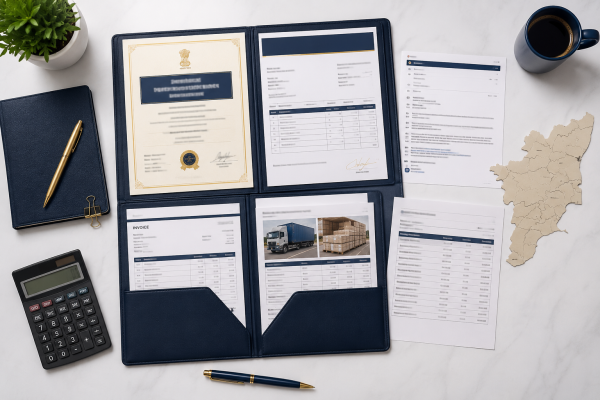
Step 2: Build an invoice recovery file
Keep the following records in date order:
- Udyam Registration Certificate and registration history
- Purchase order, work order, agreement or accepted quotation
- Invoices, tax records and delivery proof
- Service reports or completion certificates
- Emails and messages showing acceptance
- Written objections and your reply, if any
- Ledger and bank statement showing payments received
- Earlier reminders and promises to pay
- Calculation of principal and delayed payment interest
The official ODR Scheme guidelines also refer to work orders, agreements and invoices. Match each invoice with its order and delivery proof.
Step 3: Send a clear payment reminder
Your reminder should not say only, “Please pay soon.”
State the invoice number, supply details, principal due, agreed payment date, days delayed and a short reply deadline. Ask the buyer to report any real invoice issue in writing. Keep the message polite and firm.
Step 4: Send a proper demand notice
If the reminder fails, a legal demand notice can place the agreement, supply, invoices, due date, statutory interest and next step on record.
It also gives the buyer one more chance to settle. The notice should not make false threats or claim an amount without proof.
Step 5: File through the current MSME delayed payment portal
The older MSME Samadhaan filing page now directs new delayed payment applications to the MSME ODR Portal.
The portal provides a digital route from filing towards dispute resolution. The seller login uses the Udyam Registration Number, so the registration and enterprise details should be checked before filing.
Show the buyer’s details, invoice-wise principal, due dates, proof, payments received, balance and interest. Upload readable documents. Mixed totals and missing delivery records can slow the matter.
Step 6: Understand what happens before the MSEFC
Under Section 18, a payment dispute can be referred to the Micro and Small Enterprises Facilitation Council.
The process first moves through conciliation, which is a formal attempt to settle the matter. If conciliation fails, the Council may take up arbitration itself or send it to an approved centre.
The Council connected to the supplier’s location can act even when the buyer is located elsewhere in India.
Tamil Nadu has notified regional MSEFC arrangements to handle delayed payment matters, including a Chennai region and other regional jurisdictions. The correct Council depends on the supplier’s location. Tamil Nadu’s regional arrangement is recorded in the State Government notification on MSEFC jurisdiction.
Section 18 says that every reference should be decided within 90 days. Actual time may vary due to notice service, missing records, settlement talks and buyer objections. Treat 90 days as the legal aim, not a promise of payment on that day.
The buyer may claim that goods were defective, work was incomplete, the amount was adjusted or the supplier registered too late. A buyer may also raise a counterclaim in a proper case.
Your file should therefore tell the full story in date order, from order and supply to acceptance, due date and balance.
Why an MSEFC award carries real weight
If an award is made and the buyer wants to apply to set it aside, Section 19 says that a buyer who is not the supplier must deposit 75% of the award amount before the challenge can be entertained by the court.
The court may release a reasonable part of that deposit to the supplier during the case, subject to conditions.
An award may still need enforcement. Winning on paper and receiving money can be two separate stages.

Common mistakes that weaken MSME payment recovery
Avoid these errors:
- Waiting for months without sending any written demand
- Relying only on calls
- Registering under Udyam after the supply and assuming it will cover old invoices
- Filing one total without an invoice-wise table
- Claiming interest from the wrong date
- Ignoring the buyer’s written quality complaint
- Uploading unreadable records
- Hiding part payment or a credit note
- Filing in the wrong Council
- Allowing a legal time limit to pass
A truthful and well-organised claim is stronger than an inflated claim.
What if the business is not eligible for the MSEFC route?
The debt does not disappear if the special route is unavailable.
Other options may include negotiation, mediation, contractual arbitration, a commercial suit or a summary suit. The right choice depends on the contract, amount, age of debt and proof.
A bounced cheque also carries separate short deadlines.
How legal retainership can prevent the next unpaid invoice
Recovery should not begin only after money is stuck.
A legal retainership can set clear payment terms, place Udyam details on business records, create written delivery steps, schedule reminders, prepare notice formats and review old invoices monthly.
This is better than treating every delayed invoice as a fresh emergency.
Frequently asked questions on MSME payment recovery after 45 days
1. Can a buyer and supplier agree to 90 days for payment?
For an eligible micro or small supplier under Section 15, the written payment period cannot exceed 45 days from acceptance or deemed acceptance.
2. Must an MSME wait for 45 days before taking action?
No. If the written agreement fixes an earlier due date, such as 15 or 30 days, the supplier can act after that valid due date passes.
3. Is a legal notice compulsory before filing an MSEFC claim?
Section 18 creates the reference process. A prior notice is useful because it records the claim and gives a final chance to settle. Current filing rules should still be checked.
4. Can interest be claimed along with the invoice amount?
Yes. Sections 16 and 17 cover the principal and statutory compound interest, subject to proof of eligibility and delay.
5. Can a medium enterprise file an MSEFC delayed payment claim?
The special delayed payment chapter covers micro and small enterprises. A medium enterprise may need another route.
6. Can a Tamil Nadu supplier file against a buyer in another state?
Section 18(4) allows the supplier’s Council to act even when the buyer is elsewhere in India, subject to correct filing.
Final word
An unpaid invoice after 45 days is not merely an accounts problem. For a micro or small enterprise, it can become a legal delayed payment claim carrying statutory interest.
The safest plan is simple: check eligibility, identify the correct due date, collect proof, send a clear demand, calculate the claim invoice by invoice and use the current ODR and MSEFC route where it applies.
Do not wait until documents are lost or the claim becomes old.
IFF Law Attorney assists businesses with document review, payment notices, contract checks, MSEFC and arbitration support, recovery strategy and ongoing legal retainership.
The right route depends on the facts of each invoice, so the records should be reviewed before action is taken.
Disclaimer: This article is shared only for general legal information and education. It is not legal advice, does not create an advocate-client relationship and does not promise any result. Laws, portal steps, jurisdiction and facts may change. Obtain advice based on your documents before filing or taking action. This content is not a solicitation and is intended to follow applicable Bar Council rules.