

Before you send “we are terminating”
A supplier misses an important delivery. A service arrangement no longer works. A business wants to move to another provider. In each situation, ending the relationship may feel like the obvious next step. The difficult part is deciding how to do it without creating another dispute.
Contract termination is the ending of a contractual relationship under an available legal or contractual route. It needs to be distinguished from a contract simply reaching its end date, a temporary suspension and an agreed change to the arrangement.
For Indian businesses, a sensible first step is to collect the agreement and map the proposed exit before sending a final notice. This article offers an organisational checklist for that review. It does not establish whether you have a right to terminate a particular contract, and it is not a template legal notice.
Key takeaways
Identify the available exit route before sending a termination notice. Check the entire agreement, the facts, formal notice requirements and any opportunity to remedy a breach.
Build a contract-specific calendar rather than assuming a universal deadline. Plan money, continuity, handover and continuing obligations separately. Obtain independent legal advice before taking a consequential step or assuming that replacement costs will be recoverable.
Start with the exit route
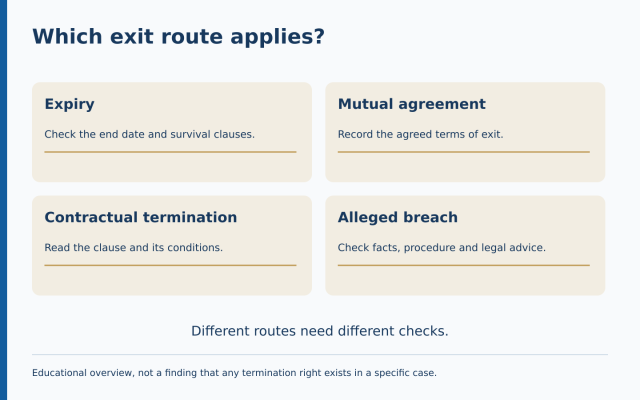
Identify what you are actually trying to do. Is the fixed term ending? Are you trying to prevent automatic renewal? Does the agreement allow termination without alleging a breach? Are both sides willing to agree an exit? Or are you relying on the other side’s alleged failure to perform?
Do not combine these routes casually. A non-renewal instruction may have a different deadline from a breach notice. A clause allowing termination for convenience may still require notice, payment or transitional work. A negotiated exit needs an agreed record of what each side accepts.
The Indian Contract Act addresses several different situations. Section 39 concerns refusal to perform, or disabling oneself from performing, a promise in its entirety, with an important qualification about acquiescence in continuation. Section 62 addresses agreed substitution, rescission or alteration. These provisions do not make every disappointing performance an automatic termination right. Read the Act on India Code alongside the actual agreement and obtain advice on its application.
Assemble the whole contract, not just the signature page
Create one review folder containing the signed agreement, schedules, purchase orders, accepted amendments and documents incorporated by reference. Include any separate service levels or renewal terms. The clause you need may sit in a schedule that the operations team rarely opens.
Record the exact legal names of the contracting parties. The brand on an invoice, the person managing the account and the company that signed the agreement may be different. Also identify who within your business is authorised to approve the proposed step.
For each version, note its date and whether it was signed or otherwise accepted. If two documents appear inconsistent, flag the conflict rather than quietly choosing the one that suits the desired outcome. A reviewer needs to know about the difficult clause as much as the helpful one.
Separate the facts from the conclusion
Prepare a short chronology before writing accusations. For each event, record the obligation, the due date, what happened, what was communicated and the supporting document. Use factual descriptions that another person could check.
For example, “the agreed report was due on 10 October and the received file omitted the two listed schedules” is more useful than “the provider is completely unprofessional.” The first statement can be examined. The second adds heat without identifying the contractual issue.
Include your own side’s dependencies. Was an approval late? Were materials or access withheld? Did someone agree a revised date? A reliable chronology contains inconvenient facts too. This helps distinguish a genuine performance failure from a disagreement caused by incomplete instructions, changed expectations or a shared delay. It also gives legal and commercial reviewers a common starting point.
Read the notice and cure provisions together
A notice clause explains how formal communications are to be given. A cure provision may give a party an opportunity to remedy a specified problem before a further step becomes available. Neither should be assumed from a generic online template.
Look for the permitted delivery method, named recipient, address, email address if allowed, required content and any deemed-receipt wording. Then examine what must happen during a cure period and how completion is assessed. Some breaches may be treated differently under the agreement.
Do not assume that a message to the usual account manager satisfies a formal notice requirement. Equally, do not conclude that every contract requires registered post. The answer depends on the contract and applicable law. If the wording is unclear, resolve that uncertainty before relying on a notice to trigger a deadline.
Build a notice calendar
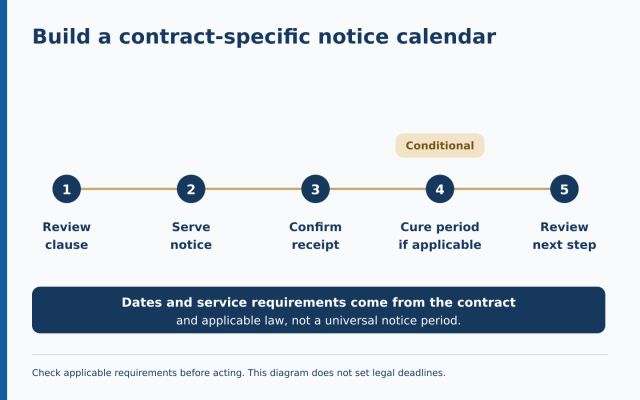
Put the proposed process on a calendar with separate entries for preparation, service, receipt, any cure period, review and the intended effective date. Distinguish calendar days from working days and check definitions in the agreement.
A useful internal calendar records the source of each date. For example: “calculated from the contractual receipt rule, subject to legal review.” This is better than an unexplained deadline that later becomes treated as fact simply because it appears in a spreadsheet.
Avoid filling the calendar with a standard seven-, fifteen- or thirty-day period taken from another contract. There is no single notice period that answers every commercial termination problem. When several clauses interact, have the calculation checked before sending anything. Keep proof of the actual service and receipt events so the calendar can be updated from evidence rather than assumptions.
A hypothetical example: a missed maintenance visit
Imagine a manufacturer has a maintenance agreement that, for this example only, requires a written breach notice and a specified opportunity to remedy before termination for that breach. A scheduled visit is missed, and the plant manager wants to cancel immediately.
The review should first establish the agreed obligation and the facts. Was the visit rescheduled? Did the manufacturer provide the required access? Does the agreement distinguish an isolated missed visit from repeated failures? What does its remedy procedure require?
If the business relies on that particular contractual route, it should not simply ignore the agreed procedure. Its advisers can assess the available rights and the appropriate next step. Separately, the operations team should address any urgent safety or continuity issue through suitable professional support.
This example illustrates a method of review, not a conclusion about a real dispute. Different wording, facts or applicable law can produce a different answer.
Plan continuity without assuming reimbursement
Before a relationship ends, identify which activities cannot be interrupted. Who will maintain essential equipment, hold customer records, complete open orders or answer urgent queries? Make a practical continuity plan, while separately checking the legal basis for any replacement work.
Do not assume that hiring another provider automatically makes the original provider liable for the bill. Section 20 of the Specific Relief Act contains a particular substituted-performance route with conditions, including a written notice of at least thirty days calling for performance. It is not a universal termination-notice rule.
The distinction matters. An operational decision to keep the business running and a legal entitlement to recover replacement costs are separate questions. Obtain advice before relying on the statutory route, claiming reimbursement or taking steps that could affect the remedy you intend to pursue.
Calculate money separately from frustration
Prepare a reconciliation showing amounts invoiced, payments made, advances, accepted work, disputed work, credits and any proposed exit charge. Label the disputed items clearly. The finance team should be able to trace each number to a record.
For a potential damages claim, identify the actual loss and its connection to the alleged breach. Section 73 of the Indian Contract Act addresses compensable loss and excludes remote or indirect loss. Its explanation also requires consideration of available means of remedying the inconvenience.
A penalty figure written into a contract is not automatically an assured recovery. Section 74 addresses reasonable compensation subject to its statutory limits. Section 75 concerns compensation following rightful rescission. A lawyer must assess the facts and applicable principles; an internal spreadsheet cannot establish entitlement by itself.
Keep cost-control decisions and supporting records. They may be more useful than a large, unsupported demand.
Plan the handover
List what must move, what must remain available and what may need to be returned. Typical categories include equipment, keys, stock, drawings, project files, licences, customer materials and administrative access. Identify ownership and contractual rights before assuming that either side may keep or withhold an item.
For digital systems, coordinate the transition with authorised technical staff. Record who will receive administrator access, how continuity will be checked and when access changes are permitted. Avoid an abrupt lockout that destroys evidence or interrupts a service without proper review.
Create a handover schedule with named owners and an acceptance record. Be precise about the condition of physical assets and the format of files. “All documents handed over” is difficult to verify; an itemised list is much easier to use. Where a dispute exists, ask advisers how to document delivery without accidentally conceding a disputed point.

Four handover categories: records, physical assets, access permissions and financial reconciliation.Check what continues after the relationship ends
The end of day-to-day work may leave obligations that require separate attention. Review clauses dealing with confidentiality, data handling, intellectual property, payment, warranties, return of property and dispute resolution. Their operation depends on the agreement and applicable law.
Do not delete business records merely because a contract has ended. First check applicable retention duties, any dispute-preservation requirement and the permitted handling of confidential or personal information. A return-or-deletion instruction may need to be reconciled with those requirements.
Prepare a short post-exit list: who keeps the records, who handles later queries, which invoices remain open and what commitments still need attention. This prevents the matter from disappearing between legal, finance and operations once the main contact has moved on. A tidy handover is useful only if the remaining responsibilities are visible.
Keep the communication controlled
Before a formal communication leaves the business, have the responsible reviewer check the route, facts, recipient, dates, requested action and signatory. Remove allegations that are not needed or cannot be supported. Avoid promises about refunds, waivers or releases unless the business has decided to make them.
Keep negotiation messages distinct from operational instructions. If the parties are discussing a mutual settlement, record which points are proposals and which have actually been agreed. Do not assume that an informal phrase preserves every legal right.
After sending, save the exact version and the transmission record. Track any response and reassess the next step rather than treating a notice as the end of the process. A reply may raise facts, propose a remedy or identify an ambiguity that needs attention before further action.
The review pack to prepare
Before deciding to end a business contract, gather the complete agreement, a factual chronology, the proposed exit route, a notice calendar, the financial reconciliation and a continuity-and-handover plan. Mark uncertainties for professional review instead of hiding them in confident wording.
This preparation helps a business make a considered decision and gives its advisers the information needed to assess the actual position. It cannot eliminate every dispute, but it can reduce avoidable confusion about what was agreed, what happened and what should happen next.
This article is provided by IFF Law Attorney for general legal awareness only. It is not legal advice, a solicitation or a prediction of any outcome. Contract rights depend on the documents, facts and applicable law. Source material was checked on 21 October 2026; seek independent legal advice before issuing a termination notice or taking consequential action.
Use the review pack to organise the facts before obtaining independent advice on a specific contract.
Sources and further reading
- India Code: Indian Contract Act, 1872
- India Code: Indian Contract Act text, section 39
- Income Tax Department statutory text: Indian Contract Act section 73
- India Code: Specific Relief Act, section 20
- Delhi District and Sessions Court: statutory text including section 62
- Income Tax Department statutory text: Indian Contract Act section 74
- Income Tax Department statutory text: Indian Contract Act section 75