
Imagine this. You run a business in Tamil Nadu. You sell goods to a customer, or maybe you give a friendly loan to someone you know. After months of asking for your money, they finally hand you a cheque. You feel a sense of relief. You drop the cheque off at your bank, expecting the money to hit your account in a day or two. But instead, you get a message from your bank: the cheque has bounced.
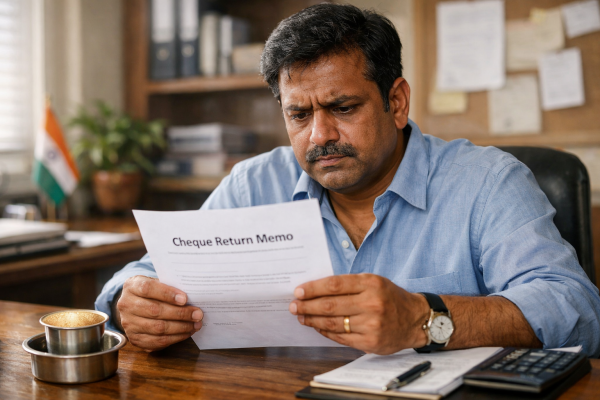
It is frustrating, right? Your hard-earned money is stuck. You might feel angry and confused about what to do next. If you are living anywhere in Tamil Nadu, from Chennai to Coimbatore or Madurai, this is a very common problem.
But do not worry. The law is actually on your side. In India, a bounced cheque is not just a broken promise; it is a serious legal offense.
IFF Law Attorney may consider enquiries relating to this topic. The available steps and scope of any engagement depend on the facts, records, applicable law and acceptance of the matter.
Let us get into it.
What Exactly is a Cheque Bounce?
Let us start with the basics. A "cheque bounce" happens when you deposit a cheque into your bank, but the bank cannot give you the money. Instead, they return the cheque to you along with a paper called a "Return Memo."
Why does this happen? The most common reasons are:
- Insufficient Funds: The person who gave you the cheque does not have enough money in their bank account.
- Signature Mismatch: The signature on the cheque does not match the signature the bank has on file.
- Overwriting: The cheque has too many scribbles or corrections.
- Account Closed: The person closed their bank account before you deposited the cheque.
When a cheque bounces because of "insufficient funds," it falls under a specific law. It is called Section 138 of the Negotiable Instruments Act. Under this law, bouncing a cheque is a crime.
The Most Important Thing: Time Limits
If there is one thing you must remember from this entire blog post, it is this: Time is everything in a cheque bounce case.
If you miss the legal deadlines by even one single day, you could lose your chance to get your money back through the criminal court. The law is very strict about these dates.
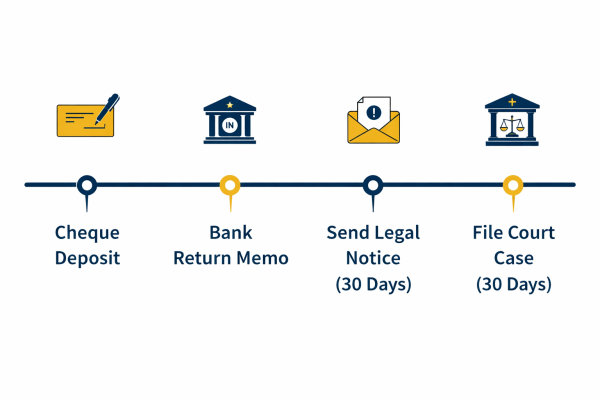
Let us look at the step-by-step timeline you must follow. I call it the "3-30-15-30" rule.
1. The 3-Month Rule: Depositing the Cheque
When someone gives you a cheque, you cannot just keep it in your drawer forever. A cheque is only valid for 3 months from the date written on it. You must deposit it into your bank before those 3 months are over. If you deposit an expired cheque, the bank will reject it, and you cannot file a Section 138 case.
2. The 30-Day Rule: Sending the Legal Notice
Let us say you deposit the cheque on time, but it bounces. The bank will give you a "Return Memo" telling you why it bounced.
From the exact date you receive this memo from your bank, a clock starts ticking. You have exactly 30 days to send a formal legal notice to the person who gave you the cheque.
This legal notice must clearly state:
- The details of the cheque.
- The reason it bounced.
- A strict demand that they must pay the exact cheque amount within 15 days.
You cannot just send a WhatsApp message or an email. It must be a proper legal notice sent through registered post with an acknowledgment receipt. This proves they actually received it.
IFF Law Attorney may consider enquiries relating to this topic. The available steps and scope of any engagement depend on the facts, records, applicable law and acceptance of the matter.
3. The 15-Day Rule: The Waiting Period
Once the person receives your legal notice, the law gives them a grace period. They have exactly 15 days to arrange the money and pay you back.
During these 15 days, you cannot file a court case. You just have to wait. If they pay you within these 15 days, the matter is closed. No crime has happened.
4. The 30-Day Rule: Filing the Court Case
What if the 15 days pass, and they still have not paid you? Now, the real legal action begins.
From the 16th day (the day after their waiting period ends), you have exactly 30 days (or one month) to file a formal criminal complaint in the Magistrate Court.
If you try to file the case on the 32nd day, the judge might throw your case out. You would have to beg the court to forgive the delay, and they only do that if you have a very, very good reason.
Let us look at a quick story to make this super clear.
A Simple Example: Ramesh and Suresh
Ramesh runs a business in Chennai. He supplies goods to Suresh. Suresh gives Ramesh a cheque for Rs. 2 Lakhs, dated January 1st.
- January 10th: Ramesh deposits the cheque.
- January 12th: The cheque bounces. Ramesh gets the Return Memo from the bank.
- Notice Time: Ramesh has 30 days from January 12th to send a legal notice. He goes to his lawyer and sends the notice on January 20th.
- Notice Received: Suresh receives the notice by post on January 25th.
- Waiting Time: Suresh has 15 days from January 25th to pay. That means he has until February 9th to give Ramesh the money.
- Case Filing Time: Suresh does not pay by February 9th. Now, Ramesh has 30 days, starting from February 10th, to file a case in the Chennai Magistrate Court. He must file the case before March 11th.
See how the dates link together? Every step depends on the previous one.
What Happens When You File the Case? (The Court Process)
Many people are scared of going to court. They think it will be like the movies, with loud arguments and dramatic music. In reality, a cheque bounce case is a step-by-step paperwork process. Here is what happens in a Tamil Nadu court after you file your case:
Step 1: Filing the Complaint
Your lawyer will draft a formal complaint and submit it to the Magistrate Court. You will need to provide all original documents: the bounced cheque, the bank return memo, a copy of the legal notice, and the postal receipt showing the notice was delivered.
Step 2: Sworn Statement
The judge will ask you to stand in the witness box and confirm that everything in your complaint is true. This is called a sworn statement. If the judge is satisfied, they will take the case forward.
Step 3: Summons to the Accused
The court will send an official order, called a "Summons," to the person who bounced the cheque (the accused). This order commands them to appear in court on a specific date.
Step 4: Appearance and Bail
When the accused comes to court, they have to apply for bail. Since cheque bounce is a bailable offense, they will easily get bail, but they have to promise to attend all future court dates. If they ignore the summons and do not show up, the judge will issue an arrest warrant.
Step 5: Framing of Notice
The judge will read the charges to the accused and ask, "Do you admit your mistake, or do you want to fight the case?" If they admit it, the judge punishes them right there. If they say they are innocent, the trial begins.
Step 6: Evidence and Cross-Examination
This is where your lawyer presents all your proof. You will give your statement. Then, the lawyer for the accused gets to ask you questions to try and find holes in your story. This is called cross-examination. After that, the accused gets a chance to show their evidence and bring their own witnesses.
Step 7: Final Arguments
Both lawyers will argue their side before the judge. Your lawyer will explain why the accused owes you the money and why they are guilty. The other lawyer will try to make excuses.
Step 8: The Judgment
The judge listens to everything, looks at the documents, and makes a final decision.
If you win, the punishment for the accused can be serious:
- They can be sent to jail for up to 2 years.
- They can be ordered to pay a fine that is up to twice the amount of the bounced cheque.
- Or, the judge can order both jail time and the heavy fine.
Usually, the court orders the accused to pay you your cheque amount plus some extra money as compensation for your trouble.
Can We Settle This Outside Court?
Yes! Absolutely. In fact, courts encourage this.
A lot of business owners in Tamil Nadu do not have the time to go to court for years. At any point during the case, if the person agrees to pay you your money, you can accept it and close the case. This is called "compounding" the offense.
This is where a good law firm is highly useful. Often, we talk to the other party, show them how strong our case is, and negotiate a full payment without letting the court case drag on.
Legal assistance in this area
Dealing with bounced cheques, unpaid bills, and tricky customers is a big headache. You should be focusing on growing your business, not chasing people for your own money.
That is exactly why IFF Law Attorney is here to help. We are a dedicated law firm based in Tamil Nadu, and we specialize in making the legal process smooth and stress-free for you.
Here is how we help people and businesses:
1. Litigation Services (Fighting in Court)
If someone has cheated you and you need to file a cheque bounce case, we handle everything from start to finish. We file the paperwork, stand before the judge, argue on your behalf, and push hard to get your money back with compensation. We know the local courts inside out.
2. Non-Litigation Services (Outside Court Solutions)
Not every problem needs a court battle. We are experts in drafting powerful legal notices. Many times, a strict, professionally written notice on our IFF Law Attorney letterhead is enough to make the other person pay up immediately. We also handle legal drafting, business contracts, and out-of-court settlements to save you time and money.
3. Legal Retainership (Your Dedicated Legal Team)
Are you a business owner running a company, a clinic, or a shop? You probably face legal questions, contract issues, and payment delays all the time.
IFF Law Attorney may consider enquiries relating to this topic. The available steps and scope of any engagement depend on the facts, records, applicable law and acceptance of the matter.

Frequently Asked Questions (FAQs)
To make this blog even more helpful, here are some common questions we get asked by our clients across Tamil Nadu:
1. Can I file a police complaint for a bounced cheque?
Normally, no. A cheque bounce is dealt with by the Magistrate Court, not the local police station. You have to file a private complaint through a lawyer. The police will only get involved if there is large-scale fraud or cheating involved.
2. What if the person who gave the cheque ran away to another city?
You can still file the case! You usually file the case in the city where you deposited the cheque. If you deposited it in your bank branch in Chennai, the Chennai court will handle it. The court will send the summons to their new address or issue an arrest warrant that the police will enforce, no matter where they hide in India.
3. The cheque bounced because of a "signature mismatch." Can I still file a case?
Yes. The Supreme Court of India has said that if a cheque is returned because the signature does not match, you can still send a legal notice and file a Section 138 case. It is seen as a trick by the drawer to avoid payment.
4. How long does a cheque bounce case take in Tamil Nadu?
It depends on the court's workload. While the law says these cases should be finished fast, realistically, it can take time to get a final judgment. That is why having a proactive lawyer who pushes for fast dates is very important.
5. Can I ask for interest on the bounced cheque amount?
Yes. When we file the complaint, we usually ask the court to give you the cheque amount along with interest and the cost of hiring a lawyer.
A Final Piece of Advice
If you take away anything from this blog, let it be this: Do not sit on a bounced cheque. Every single day counts. The moment your bank tells you the cheque has bounced, pick up the phone and talk to a lawyer.
If you miss the 30-day deadline to send the notice, your legal right to fight under Section 138 is gone forever. You might still be able to file a civil recovery suit, but that takes much longer and is not a criminal offense, meaning the other person will not be scared of going to jail.
Protect your money and protect your business. Be alert and act fast.
If you are dealing with a bounced cheque, or if your business needs strong legal support, we are just a message away. Reach out to IFF Law Attorney today. Whether you need litigation, non-litigation advice, or a reliable retainership partner, we are ready to stand by your side.
Let us handle the legal headaches so you can focus on what you do best!