
When a business disagreement may involve emails or WhatsApp messages, preserve the underlying records, their attachments and the surrounding conversation. Keep a secure source copy, document how it was collected and use separate working copies for review. A few cropped screenshots rarely provide the same context as a carefully organised record.
This educational guide from IFF Law Attorney explains practical records-handling questions for Indian businesses. It does not determine whether a particular message is admissible, prove that its sender had authority or predict the outcome of a dispute. Those questions require the applicable law, the facts and appropriate professional review.
The aim is to avoid preventable loss or confusion before someone needs to examine the record. The same approach can help with disagreements about delivery, instructions, quality, approvals or business communications, without assuming that litigation is inevitable.
Start with the question the record may help answer
“We have the WhatsApp chat” is only the beginning. Which conversation matters? What event is in dispute? Who participated? Was a file attached? Was an instruction later clarified or changed by email?
Write a short neutral description of the issue, such as: “The parties disagree about which artwork version was approved.” Avoid turning the collection task into an accusation. The description helps staff locate relevant material without deciding its legal meaning.
Identify likely sources: relevant business mailboxes, authorised messaging accounts, project folders, customer-management systems and devices. Keep track of who ordinarily uses or manages each source.
Collect material that may qualify or contradict your preferred account as well as material that supports it. Selective capture can leave the reviewer with a misleading picture and create extra work when missing context appears later.
Understand the legal framework without assuming automatic acceptance
The Bharatiya Sakshya Adhiniyam, 2023 recognises electronic and digital records within its definition of documents. Sections 61–63 address electronic evidence, including conditions for computer outputs and certificate requirements.
Section 63(4) concerns the certificate accompanying a record submitted under that provision. Its Schedule contains a party component and an expert component, including identifying information and hash details. A lawyer and, where needed, a suitable digital-forensics professional should assess the required production method and certificate for the actual material.
The Act’s application provision excludes proceedings before an arbitrator. Section 170 also preserves the earlier Indian Evidence Act framework for specified matters pending immediately before commencement. Do not select a certificate template solely because a search result calls it the latest format.
These provisions do not make every screenshot self-proving. The forum, applicable framework, source, authenticity and surrounding facts still need examination. Preservation is preparation for that examination; it is not a declaration that a document will be accepted or that the claim succeeds.
Keep context that a screenshot can leave out
A screenshot can help someone locate a particular exchange quickly. Its limits should be visible. A cropped image might exclude earlier questions, later corrections, the identity behind a saved contact name or the attachment to which “approved” refers.
For a relevant conversation, consider preserving:
- The surrounding messages needed to understand the exchange
- Dates, times and any visible time-zone information
- The account identifiers or contact details available through lawful access
- Attachments, voice notes and linked documents that matter to the issue
- Records connecting the exchange to the relevant project or transaction
- Any visible indication that material is missing or unavailable
Keep captured screenshots unaltered in the preserved set. If a working copy needs highlighting or redaction for a particular review, label it clearly and retain the untouched version separately.
Do not rename a contact and then present a fresh screenshot as though the new label were an original identity record. A familiar name on a screen is a useful lead, but independent business records may be needed to establish who the account belongs to and what role that person had.

Preserve emails in a form that keeps useful information
Printing an email to PDF may make it easier to read, but treat that as a review format rather than the only retained version. Where the mail system allows it, preserve the message in its available native or export format, together with attachments and relevant mailbox context.
For example, Google’s Gmail instructions explain downloading an individual message, which produces an EML file. The appropriate method for an organisation-wide collection may be different and should be handled by an authorised administrator or specialist.
Do not assume a forwarded message retains every useful feature of the original. Keep the source message where possible. Also check whether a supposed attachment is actually a link to a cloud document whose content or access could change.
For a linked document, record what was accessible at the relevant time if that can be established, its location and any available version history. Avoid claiming that a file downloaded today necessarily matches the version a recipient viewed months earlier.
If a mailbox export is incomplete or a file cannot be opened, record the limitation. A clear note about a gap is better than quietly substituting a different version.
Handle messaging exports carefully
Use the messaging service’s current supported export guidance rather than an unfamiliar recovery application. WhatsApp’s official chat-export guidance is a starting point for the export feature, but the available result can depend on the app, device and content.
After an authorised export, check its date coverage and whether relevant media is present. Note whether the result contains only text, separate media files or other limitations. An export should not be labelled complete merely because the operation finished.
Keep the source device and account situation in mind. If a phone is about to be replaced, repaired, reset or reassigned, obtain advice before routine changes destroy potentially relevant information. Do not experiment with recovery tools on the only available device.
For substantial or contested matters, a specialist can advise on collection methods that better preserve technical information. An ordinary chat export and a forensic acquisition serve different purposes; the right choice depends on what needs examination.
Access only accounts and devices you are authorised to use. Do not guess passwords, secretly access someone’s personal account or encourage an employee to extract another person’s private conversations. Mixed personal and business data requires particular care and a properly defined collection scope.
Separate the preserved set from everyday review
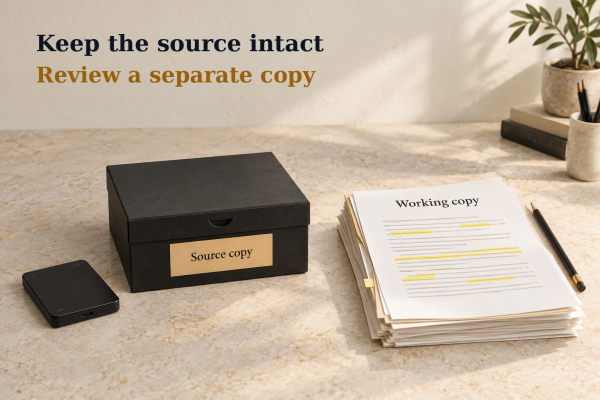
Create a controlled location for the preserved material, with access limited to people who need it. Use a separate working set for reading, annotations, translations and issue summaries. Keep a record of where both sets are stored.
The US National Institute of Standards and Technology’s digital-evidence preservation guidance discusses integrity, handling and documentation. It is technical guidance, not Indian evidence law. One useful principle is that an organisation should be able to explain how records were maintained and protected from unexplained change.
A cryptographic hash can help identify a particular file and check whether its digital contents have changed since hashing. It does not, by itself, establish that the original contents were truthful, that a sender had authority or that collection was lawful. Ask a competent person to select and document the method where hashing is appropriate.
Keep enough information to connect any reported hash to the exact file, algorithm and collection event. Storing a string of characters without that context can create another unexplained item in the file.
Maintain a collection log another person can follow
A simple log makes the collection easier to review. It should describe what actually happened, without trying to turn an informal process into a forensic claim.
- Record identifier: A unique reference for the item or export
- Source: The mailbox, account, system or device involved
- Collector: The authorised person who performed the collection
- Date and time: Including the time zone where known
- Method: The tool or export function and relevant settings used
- Coverage: The period, conversation or files captured
- Limitations: Missing media, unavailable messages or other known gaps
- Storage and handling: Where the preserved copy went and any subsequent transfer
If a material detail was not recorded at the time, do not invent it later. A later note can identify the source of the recollection and distinguish what is certain from what remains unknown.
Ask reviewers to reference the record identifier in their comments. That allows the original material to be found without relying on descriptions such as “the latest screenshot” or “the final final folder.”
A hypothetical example: which design was approved?
Imagine a small business and a supplier disagreeing about the version of a product label approved for production. This is a fictional scenario for illustration, not an IFF client matter or a reported court outcome.
The business has a screenshot saying “Please proceed.” The supplier has a later email mentioning a revised file. Neither excerpt explains the whole sequence.
An organised review would locate the relevant conversation, preserve the attached files, identify the email chain and trace how the versions were named and shared. The collection log would record which account supplied each item and any gaps in the available history.
A separate chronology could then list the request, the draft sent, the clarification and the response. Each entry would link back to a preserved record rather than rely on someone’s memory of the exchange.
The reviewer may still need to investigate authority, meaning and the parties’ contractual arrangements. The practical benefit is a clearer body of material to examine. No legal result follows automatically from having assembled it neatly.
Prepare a useful handover for professional review
A reviewer needs orientation as well as files. Prepare a short factual note explaining the issue, the people and business roles involved, the important dates and the records available. Identify urgent events such as a device replacement or a known retention deadline.
Include a chronology with record references, a list of missing items and the collection log. Keep observations separate from conclusions. “The email attachment is unavailable in this export” is different from “the other party deleted the evidence.”
Preservation does not suspend claim deadlines or satisfy notice requirements. Ask promptly about any applicable timetable instead of waiting until every file has been organised. The correct deadline depends on the matter.
Share the material through an appropriately controlled channel agreed with the reviewer. Avoid forwarding full business conversations into large groups or uploading confidential records to unapproved conversion, transcription or AI services merely for convenience.
Build everyday habits before a dispute
Businesses can make future review less difficult by using approved communication channels, consistent project references and sensible file naming. Record important clarifications in the ordinary course of work while participants still remember the context.
Agree who owns the records when staff leave or devices are replaced. Ask legal, IT and relevant business teams to align retention practices with applicable obligations and genuine operational needs. There is no single retention period established by this article.
When a specific dispute becomes apparent, seek advice about targeted preservation and any routine deletion that should be paused. Avoid both indiscriminate collection of everyone’s personal data and selective deletion of inconvenient material.
Frequently asked questions
Are screenshots useless?
No. They can be useful supporting material and a convenient way to locate an exchange. Preserve surrounding context and source records where possible, and obtain advice about how the material should be produced.
Does a chat export prove who sent a message?
An export is one piece of information. Identity, account control, context and the meaning of the message may need other evidence. Avoid assuming that a saved contact name resolves those questions.
Can we highlight or translate the messages?
Use clearly labelled working copies for those tasks and preserve the untouched source material. Record who prepared a translation and have the required form of translation assessed for the intended use.
Should we install a recovery app immediately?
Do not experiment on the only source device in a potentially important matter. Explain the missing material and device status to a suitable professional before changes create further uncertainty.
Will a certificate guarantee acceptance?
No guarantee should be assumed. The correct certificate and production process require case-specific assessment, and the material’s relevance and reliability remain important.
Keep the record understandable and intact
A practical starting point is to identify the issue, preserve relevant source material lawfully, document collection and make separate review copies. Keep gaps visible and obtain advice before important records are lost or changed.
General educational information, checked against the linked sources on 7 October 2026. It is not a substitute for advice on a particular dispute, forum or electronic record.
Sources and further reading